
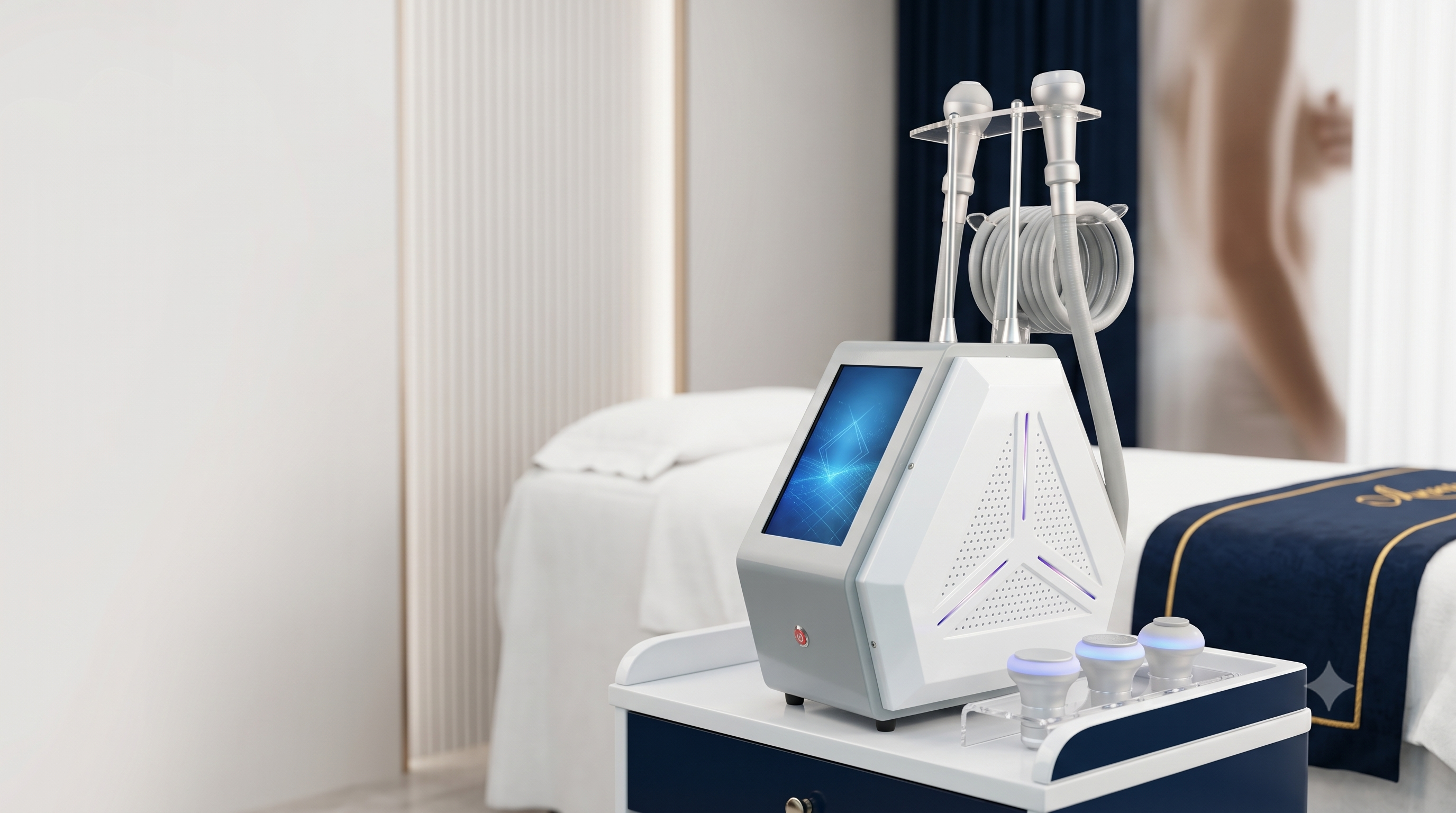
How to Choose a Body Contouring Machine for Your Spa (2026 Buyer's Guide)
A practical, no-hype guide for spa and clinic owners comparing the main non-invasive body-contouring technologies — by results, ROI, footprint, and client fit — so you buy the right platform the first time.
The short answer
There is no single "best" body-contouring machine — the right choice depends on what your clients ask for and how you bill. As a quick orientation:
- Fat-pocket / inch-loss focus → Cryolipolysis (fat-freezing) or thermal-shock cryo systems have the most recognized "fat reduction" story.
- Lax skin + mild fat → Radiofrequency (RF) platforms, which heat the dermis to support firmness.
- Small, precise fat deposits → HIFU (focused ultrasound).
- Muscle tone + fat → HIFEM/EMS muscle-stimulation devices.
- Entry-level / mixed menu on a budget → Ultrasonic cavitation or a multi-mode cryo + thermal system.
The strongest clinical evidence for localized fat reduction sits with cryolipolysis; the strongest muscle-building data sits with HIFEM. Many top studios run a combination menu rather than a single device.
If you own or manage a spa, med-spa, or aesthetic clinic, a body-contouring machine is often your highest-ticket equipment decision and one of your best recurring-revenue services. But the category is crowded with overlapping technologies and big marketing claims. This guide breaks down the real differences — mechanisms, what the research actually supports, typical session pricing, and the practical buying factors that matter once the machine is in your treatment room.

The 6 main technologies, compared
Non-invasive body contouring devices aim to reduce subcutaneous fat, tighten skin, or build muscle — without cutting the skin. Here's how the leading approaches differ.
| Technology | Primary goal | How it works | Best client fit | Typical retail / session* |
|---|---|---|---|---|
| Cryolipolysis (fat-freezing / vacuum applicator) | Localized fat reduction | Controlled cooling triggers fat-cell apoptosis; body clears cells over weeks | Defined fat pockets — flanks, lower abdomen, thighs | ~$400–$1,000 |
| Cryo + thermal shock (e.g., Cryoskin-type) | Contouring + cryo facials | Alternating cold/heat over the skin surface; gliding handle, no vacuum | Spas wanting face and body from one device | ~$80–$250 |
| Radiofrequency (RF) | Skin tightening (+ mild fat) | Heats the dermis to stimulate collagen remodeling | Lax / crepey skin, post-fat-loss firming | ~$300–$1,200 |
| HIFU (focused ultrasound) | Targeted fat + lift | Focused sound energy heats deeper tissue at precise depths | Small, precise deposits; jawline/submental | ~$500–$1,500 |
| HIFEM / EMS (muscle stimulation) | Muscle building + fat | Electromagnetic pulses force intense muscle contractions | Clients wanting tone/definition, not just inch loss | ~$400–$1,000 |
| Ultrasonic cavitation | Entry-level fat / cellulite | Low-frequency ultrasound disrupts fat cell walls | Budget menus, cellulite appearance | ~$75–$200 |
*Illustrative market ranges for what clinics charge clients per session/area; varies widely by region, device, and operator. Confirm against your local market.
What the research actually supports
Marketing claims run ahead of the evidence in this category, so it pays to know what's genuinely backed by studies — and where the literature is honest about limits.
Cryolipolysis has the deepest fat-reduction evidence
A 2025 PRISMA systematic review and meta-analysis found cryolipolysis effective for reducing local circumference and fat-layer thickness, while explicitly noting it does not significantly change overall body weight, with benefits stronger in short-term follow-up and varying by region. A widely cited 2023 review reported roughly a 46% reduction in abdominal fat-layer thickness at six months after a single CoolSculpting treatment (ultrasound-measured).
Sources: World J Plast Surg systematic review 2025 (PMID 41607567); J Cosmetic Dermatology 2023 review. Note these used controlled vacuum-applicator, FDA-cleared cryolipolysis devices — they define the category, not any one machine.
HIFEM leads for muscle building
Electromagnetic muscle-stimulation studies report meaningful muscle-mass increases (roughly 16–18% in treated areas) — a different outcome from fat reduction. If clients ask for "tone" and definition rather than just inch loss, this is the category with the supporting data.
Source: PMC electromagnetic body-contouring reviews.
RF, HIFU, laser and cavitation: real but moderate
A peer-reviewed review of non-invasive contouring concluded that cryolipolysis, RF, low-level laser and HIFU all showed statistically significant effects on fat/cellulite in some areas — but circumference changes across the category have generally been moderate (about 2–4 cm) over several sessions, and combination protocols (e.g., cryo + shockwave, or EMS + cryo) often outperform any single modality.
Sources: Review of non-invasive body contouring devices, PMC5236497; feasibility studies on combination therapy.
7 buying factors that matter more than the brochure
- Client demand first, technology second. Survey what your existing clients actually ask for — facials, inch loss, skin tightening, or muscle tone — and buy to that, not to the flashiest claim.
- Single-purpose vs. multi-service. A device that does both face and body (e.g., a cryo + thermal-shock system) fills more of your appointment book than a single-application machine, especially for a smaller studio.
- Revenue per hour, not just price per session. A 14–20 min facial you can run between other services often beats a 60-min single-zone treatment on hourly room economics.
- Consumables. Watch for devices needing proprietary cartridges or membranes — they quietly erode margin. Gel-only systems keep cost-per-treatment near zero.
- Footprint & power. Benchtop vs. trolley vs. portable changes what fits your room and whether you can move it between sites.
- Certification & claims discipline. Know whether a device is CE, FDA-cleared, or neither, and keep your own marketing within what its regulatory status supports. Over-claiming is the fastest route to a complaint.
- Training, warranty & support. A 2-year warranty, real onboarding, and fast spare-parts turnaround protect your uptime — downtime on a high-ticket service is expensive.

Doing the ROI math
A professional contouring or cryo-facial platform commonly runs $1,500–$3,000 to acquire. If cryo facials retail at $80–$150 and body sessions at $100–$250 — sold in packages of 5–10 — many studios recover the device cost within roughly 11–25 sessions. With gel as the only consumable, nearly everything after payback is margin. The real lever is rebooking: package-based, results-over-time services turn one client into a multi-session relationship.
Where a cryo + thermal-shock system fits
For a spa or clinic that wants a single platform covering both cryo facials / skin firming and non-invasive body contouring, a thermal-shock system is a practical "two menus, one machine" entry point — lower acquisition cost than multi-platform RF/HIFEM towers, gel-only consumables, and a footprint that suits most rooms.
Our Cryoskin C8 Thermal-Shock System is built for exactly this profile: heat→cold→heat cycling plus continuous cooling, 30/50/70 mm handles for face and body, CE certified, 2-year warranty, free training, and free worldwide shipping. You can also browse our full cryotherapy machine collection.
Not sure which platform fits your client base?
We're the manufacturer — tell us your services and room setup, and we'll give you a straight answer.
Talk to NEWBELLE →Frequently asked questions
What is the best body contouring machine for a small spa?
For a smaller spa, a multi-service device that handles both face and body — such as a cryo + thermal-shock system — usually delivers the best return, because it fills more appointment types from one investment with minimal consumables. Larger clinics chasing specific outcomes (muscle building, deep skin tightening) may justify dedicated HIFEM or RF platforms.
Do body contouring machines cause weight loss?
No. The research shows these technologies can reduce localized circumference and fat-layer thickness or build muscle in treated areas, but they do not significantly change overall body weight. They're appearance and contouring services, best paired with realistic client expectations.
Cryolipolysis vs. radiofrequency — which should I buy?
Choose cryolipolysis (or cryo thermal-shock) if your clients want inch loss on defined fat pockets; choose RF if they mainly want skin tightening and firming. Many studios eventually offer both, since they address different complaints and pair well in a package.
How much do these machines cost to buy?
Professional non-invasive contouring platforms commonly range from about $1,500 to $3,000 for entry-to-mid systems, with multi-platform RF/HIFEM towers costing considerably more. Factor in consumables, training, warranty and support — not just the sticker price.
How many sessions do clients need?
Most protocols run a course of 5–10 weekly sessions with maintenance afterward. Results build over the course rather than appearing after one visit, which is why package pricing works well for both client outcomes and clinic revenue.
What certifications should the device have?
At minimum, look for CE and RoHS compliance. Some devices are also FDA-cleared; some are not classified as medical devices at all. Whatever the status, keep your clinic's marketing claims within what that regulatory classification supports.
This article is general educational information for aesthetic professionals and is not medical advice. Clinical references describe the cryotherapy/body-contouring category and the specific devices studied; they are not performance claims for any individual product. Always operate equipment per your training and local regulations.